
Copper Is Not One Business
A map of the chain, from ore to wire, for anyone buying the electrification trade.

Copper has had a remarkable run, and the reason is no secret: electrification is the defining industrial theme of the decade, and copper is the metal it runs on. Grids, EVs, data centres, renewables, every one of them is copper-hungry, and in a country like India, where the grid build-out and energy transition are only getting started, the megatrend case almost writes itself. So investors are looking at copper. Understandably.
But here’s the problem: the rock that comes out of the ground and the wire that goes into a wall are separated by a chain of distinct operations, each with its own economics, its own margins, and its own way of quietly misleading you. A miner, a smelter, a refiner, and a fabricator all call themselves “copper companies,” and they make money in almost entirely different ways. Buy the wrong rung of that ladder and you can be completely right about the megatrend and still lose.
This post is the map. It’s what I’d want to have read before putting a rupee into copper, because the copper world is more complicated than the trade makes it look, and most of that complexity is invisible until you go looking for it.
Almost everyone has read the words anode and cathode in a copper company’s filings; almost no one can tell you why the difference matters, or where the money actually hides between them. And here’s the puzzle that should stop you: the treatment charge, the fee that is supposed to be a smelter’s entire reason to exist, has collapsed to zero, and in places gone negative. By every textbook account, that should have shut the smelters down. It hasn’t. They’re still running, still profitable. Understanding why is the difference between seeing the copper trade and seeing the copper business
The Master Variables — Ore Grade, Ore Type, and Why Geology Dictates the Process
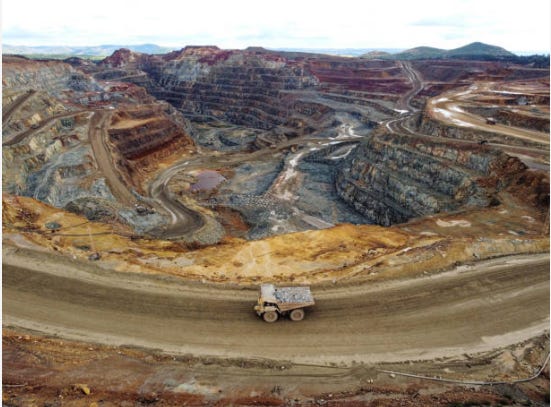
Before any producer chooses a mining method or a processing route, the orebody has already dealt the fundamental hand. Four geological variables dominate: grade, mineralogy, depth/geometry, and by-product content.
Ore grade, the percentage of copper in the rock, is the single most important cost variable in the industry. It has fallen structurally: globally the average grade has declined from around 2% in the early-to-mid twentieth century to roughly 0.5–0.6% today.
The arithmetic is unforgiving: at 1.5% grade you process about 67 tonnes of ore per tonne of refined copper; at today’s grades you process on the order of 167 tonnes. Every tonne of that rock must be drilled, blasted, hauled, crushed and ground regardless of how much copper it contains, so as grade falls the fixed cost of materials handling is spread over less contained metal and unit cost rises. Many marquee mines now run well below 1% Escondida’s feed grade was 1.02%
Mineralogy is the most important geological fork because it dictates the entire downstream processing route. Sulphide ores, chalcopyrite (CuFeS₂, the dominant and most abundant), bornite and the secondary sulphide chalcocite, cannot be dissolved economically in acid and must be processed pyrometallurgically: concentrated by flotation, then smelted and refined. These account for roughly 80% of primary production. Oxide ores, malachite, azurite, chrysocolla, form in the weathered near-surface zone of a deposit and are readily soluble in dilute sulphuric acid, making them amenable to the cheaper, lower-capital hydrometallurgical route. This is emphatically a geological given rather than a free producer choice: you leach oxide because it leaches and you float-and-smelt sulphide because it does not. The remaining geological variables shape cost within the chosen route.
Depth and geometry determine whether a deposit is mined open-pit or underground and by which underground method.
Mining — The Extraction Step and Its Central Choice
The first consequential method choice is open-pit versus underground, and it is fundamentally a trade-off between operating cost per tonne and capital cost plus access to grade.
Open-pit mining delivers ore at very low operating cost, on the order of $1/tonne of ore for the mining step itself, with large open-pits in the Americas historically moving material at $0.20–0.30 per tonne, because enormous shovels and haul trucks achieve massive economies of scale. Its constraint is that it can only reach ore near surface and must strip waste to do so; as the pit deepens, the strip ratio climbs and each incremental tonne of ore carries more waste-movement cost.Open-pit therefore suits large, low-grade, near-surface porphyry deposits where scale offsets low grade.
Underground mining costs substantially more per tonne, often an order of magnitude more, but reaches deeper, higher-grade orebodies that a pit could never economically strip down to. Within underground methods, the trade-off between cost and selectivity is stark. Block caving (and its variant panel caving) is the lowest-cost, highest-volume underground method: engineers undercut the base of a large orebody and let it collapse under its own weight, drawing the broken ore off through drawpoints.
A tonne of ore from a block cave costs roughly $5–7 to produce versus about $1 open-pit, but that is remarkably cheap for underground and comparable to open-pit once the pit’s waste-stripping is added back.
The catch is capital and time: a block cave requires building a vast fixed infrastructure of extraction, undercut, haulage and ventilation levels before it produces a tonne, so upfront capital runs $2–10 billion and lead times stretch over a decade, with acute geotechnical and ramp-up risk.
The strategically important trend is the industry-wide shift toward underground and block caving as open-pit orebodies deplete.This shift structurally raises capital intensity and lengthens lead times across the industry, pushing up the incentive price.
Comminution and Concentration — Turning Ore Into Concentrate
Once sulphide ore reaches the concentrator, it must be reduced in size and the copper minerals physically separated from the worthless gangue. Comminution, crushing followed by grinding in semi-autogenous (SAG) and ball mills, is the most energy-intensive step in the entire mine-to-concentrate chain and frequently the single largest energy consumer at the mine. Surveys of Canadian copper concentrators found grinding consuming an average of 11.6 kWh per tonne against just 2.2 kWh for crushing and 2.6 kWh for flotation.
The energy required is driven by ore hardness and the target grind size: the finer you must grind to liberate the copper minerals, the more energy and cost you incur.
Froth flotation then performs the separation. Ground ore is slurried with water and reagents, collectors that render the copper-sulphide surfaces water-repellent.
The hydrophobic copper minerals attach to the rising bubbles and are skimmed off as a concentrate grading roughly 25–30% copper, while the gangue sinks and is discharged as tailings.
The method and design choices here have direct cost consequences: a finer grind improves liberation and recovery but consumes more energy.
The Pyrometallurgical Route — Smelting and Its Technology Choices
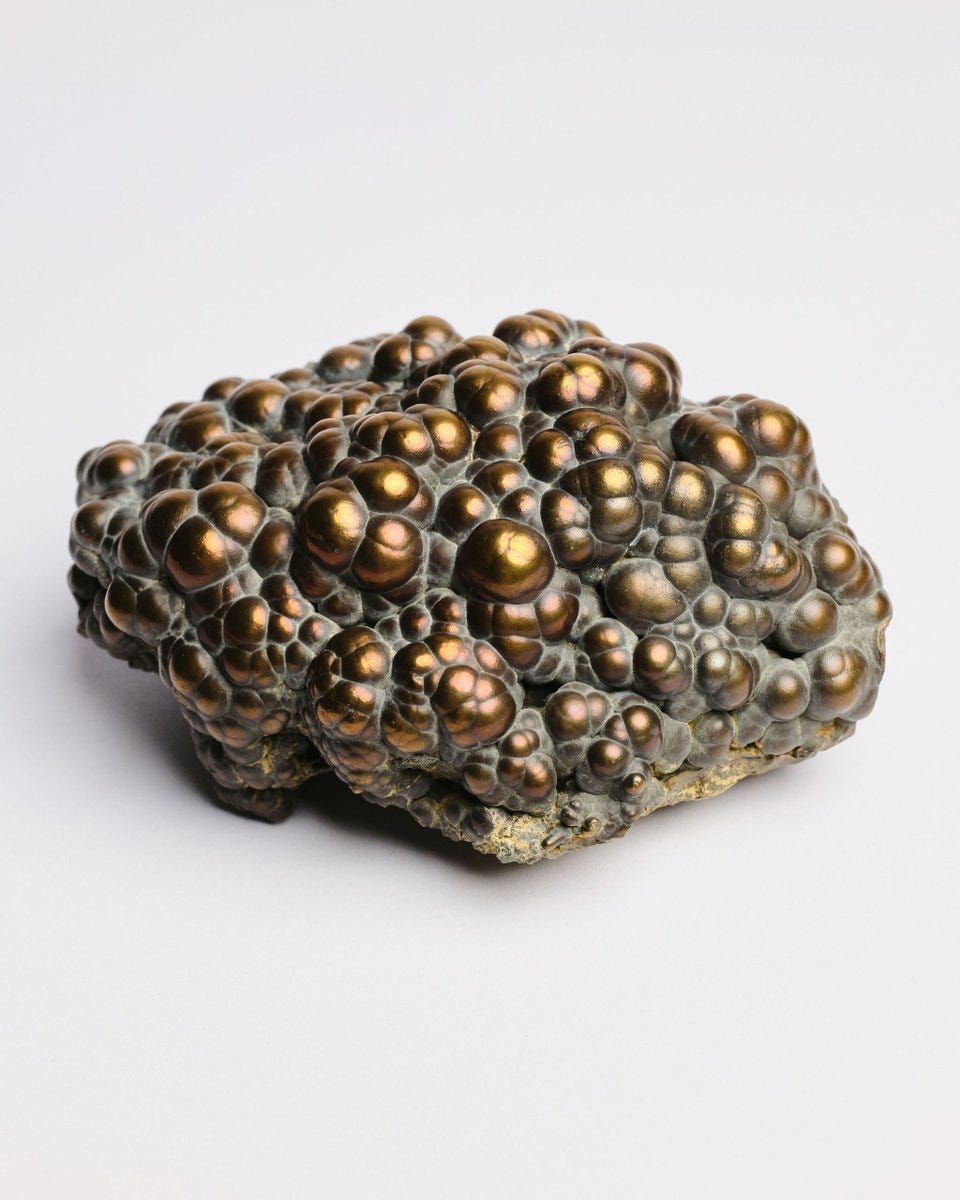
The sulphide concentrate, about 25–30% copper, the balance mostly iron and sulphur, is sold or shipped to a smelter, where high-temperature chemistry drives off the iron and sulphur.
The iron oxidises and combines with the silica to form a slag that is skimmed off; the sulphur oxidises to sulphur dioxide gas, which is captured and converted to sulphuric acid; and what remains is a molten matte of roughly 58–70% copper.
The essential economic feature of modern smelting is that it is autogenous, the oxidation of the iron and sulphur in the concentrate generates most of the heat the process needs, so little external fuel is required and waste heat can be recovered.
Two families of technology compete. Flash smelting — disperses dried concentrate and flux in the oxygen-enriched blast so that the particles react almost instantly in suspension.
It is the dominant modern technology, accounting for roughly 43% of global smelting capacity and used for well over half of world primary copper, prized for energy efficiency, high throughput and excellent sulphur capture, it produces a matte of about 60–70% copper.
Bath smelting technologies react concentrate within a molten bath
The trade-offs among these technologies run along capital cost, energy consumption, throughput and scale, SO₂-capture efficiency, feed flexibility (bath processes generally handle a wider or wetter feed and some recycled material better; flash requires dry, fine feed and cannot easily treat scrap), and copper losses to slag.
For the miner, though, the smelter’s internal technology matters less than the price of its service: the treatment charge (TC), levied per dry tonne of concentrate, and the refining charge (RC), levied per pound. These are the miner’s economically relevant deduction, and they have collapsed toward zero amid concentrate scarcity, a dynamic developed later in this post
The Hydrometallurgical Route
Where geology provides oxide ore (or, increasingly, leachable secondary sulphide), the entire pyrometallurgical chain is bypassed in favour of a three-stage hydrometallurgical route that runs at ambient temperature and far lower capital cost. Roughly 20% of world copper is produced this way — closer to 40% in Latin America and around 30% in the United States historically, with Chile the dominant SX-EW cathode producer.
The first stage is leaching. In the standard heap-leach configuration, crushed oxide ore is stacked on a lined pad,and dilute sulphuric acid is dripped over the top. The acid percolates down through the heap, dissolving the copper into a “pregnant leach solution” (PLS) that drains off the base into ponds.
The second stage is solvent extraction (SX). The dilute, impure PLS is contacted with an organic extractant that selectively binds copper and rejects iron and other impurities; the loaded organic is then stripped with a strong acid electrolyte, releasing the copper into a clean, concentrated solution suitable for plating.
The third stage is electrowinning (EW). Copper is plated from the purified electrolyte onto cathodes using inert (insoluble) lead-alloy anodes, producing 99.99% cathode directly, the same saleable product as electrorefining, but reached without ever smelting. The important technical and cost distinction is that electrowinning is markedly more electricity-intensive than the electrorefining of anodes.
In electrorefining, copper simply dissolves off a copper anode and re-plates, which is electrochemically cheap; in electrowinning the inert anode instead splits water (evolving oxygen), a reaction that consumes substantially more energy.
Order-of-magnitude figures illustrate the whole route’s efficiency advantage: heap leaching a 1% ore might require ~225 kWh/tonne-Cu and electrowinning ~500 kWh/tonne, against ~6,000 kWh/tonne for smelting — so despite EW being power-hungry relative to electrorefining, the hydrometallurgical route as a whole is far less energy-intensive than the pyrometallurgical one.
India runs almost entirely on the pyrometallurgical route — smelting and electrolytic refining of copper sulphide concentrate. Hydrometallurgy (leaching → SX-EW) is a rounding error here.
The reason is ore chemistry and the smelting business model. India’s own mined ore (HCL’s Malanjkhand, Khetri, Singhbhum belt) is chalcopyrite-dominant — copper sulphide, not oxide. Sulphide concentrate is the natural feed for the pyro route: flash/bath smelting → converting → fire refining → anode casting → electro-refining to cathode. The sulphur in the ore is itself fuel, so the process runs largely autogenously and captures SO₂ as sulphuric acid as a byproduct (the acid stream is a meaningful economic tail.
More importantly, the two large private smelters — Hindalco’s Birla Copper (Dahej) and the now-shuttered Vedanta Sterlite (Tuticorin) — are custom smelters. They import sulphide concentrate against TC/RCs rather than relying on domestic mine supply, and imported concentrate is sulphide, which locks them into the pyro route regardless of what’s in Indian ground. HCL is the same route on domestic feed.
Integration vs Selling an Intermediate — The Make-or-Buy Choice
A miner producing sulphide concentrate faces a vertical-integration decision: sell the concentrate to a third-party smelter and accept the TC/RC deduction, or integrate forward into its own smelting and refining. The economics turn on the TC/RC.
When the miner sells concentrate, the smelter pays for roughly 96.5% of the contained copper (a small fixed deduction) at the LME price, then charges a treatment charge per dry tonne and a refining charge per pound; these together are the smelter’s principal revenue and, per CRU, amount to roughly 15% of a typical miner’s realisation cost structure.
Historically the annual benchmark TC/RC has been meaningful — around $80/tonne, but as smelting capacity, overwhelmingly in China, outran concentrate supply, the charges collapsed.
The 2025 benchmark, agreed between Antofagasta and a Chinese smelter, settled at $21.25/tonne and 2.125 cents/lb (a drop of about 73% from 2024), and the 2026 benchmark, set on 19 December 2025, settled at $0/tonne, the lowest ever agreed in annual negotiations.
Spot terms went further into negative territory: per ChemAnalyst, spot treatment charges recently hit around minus $126.80 per tonne, meaning smelters were effectively paying miners more than the value of the contained metal for the privilege of processing it. For the miner, collapsing TC/RCs are a direct windfall, they shrink the deduction from concentrate revenue and lower reported C1.
The structural result is that most Western miners sell concentrate to custom smelters, while the smelting industry itself has consolidated in China. CRU estimates China holds about 45% of world smelting capacity and 87% of the region’s smelting assets are custom smelters, yet China produces only about 10% of concentrate; North American and Oceanian smelters, by contrast, are largely integrated with their owners’ mines, and Japan sits in between (about 42% integrated, a legacy of financing mines for equity and offtake).
The commercial models are integrated (concentrate from a single owned mine), partially integrated, and custom (feed procured on the open market). In the current zero-TC environment, custom smelters outside China are being squeezed toward or below breakeven while integrated Chinese producers, buffered by scale, state support, sulphuric-acid and precious-metal by-product revenue, and vertical integration into copper products, keep running.
Resource-nationalism policies reinforce integration: Indonesia’s export restrictions drove Freeport to build the Manyar smelter in Gresik, integrated with Grasberg. The investor’s takeaway is that the miner-smelter split of value has swung sharply toward miners, that a mine selling concentrate now retains almost the entire metal value less freight and payability, and that the location and ownership of smelting capacity is now a strategic and geopolitical variable in its own right.
Capital Intensity and Sustaining Capital
The capital cost of building and maintaining copper supply is what separates the operating cost curve from the incentive price, and it is rising structurally. Capital intensity is measured as development capital per annual tonne of capacity. Brownfield expansions of existing mines run roughly $8,000–15,000 per annual tonne, while greenfield projects run $25,000–40,000; S&P Global’s analysis of 26 upcoming projects to 2030 put the weighted-average capital intensity at $22,359 per tonne of annual paid copper, and UBS/Wood Mackenzie put upcoming average capex intensity around $26,500/tonne. The IEA notes brownfield capital intensity alone has risen 65% since 2020, approaching greenfield levels.
Three forces drive the escalation. First, declining grades force ever-larger throughput to produce the same metal, enlarging every piece of the plant. Second, the shift to deep underground block caving replaces cheap pit stripping with billions in cave-establishment capital and adds a decade of pre-production development. Third, lead times have lengthened to around 17–18 years from discovery to production, and discovery itself has dried up, only about 5% of the copper discovered in the last 35 years was found in the last decade.
On top of development capital, mines carry ongoing sustaining capital, fleet replacement, tailings-dam raises, deepening, equipment overhauls, that C1 excludes but a true all-in cost must include; Wood Mackenzie’s C1-plus-sustaining-capex measure for 2025 was around 183 cents/lb globally.
This is why the incentive price ($5.50/lb-plus on some estimates, or greenfield break-evens implied above $20,000/tonne) sits so far above the cash-cost curve, and why brownfield expansions and restarts, which reuse existing infrastructure at roughly a quarter of greenfield cost, are attracting disproportionate capital in the current cycle.
What Anode and Cathode Actually Are
From concentrate, the pyrometallurgical chain proceeds through a sequence of increasingly pure molten and solid forms. Smelting the concentrate produces copper matte, a copper-iron-sulphide melt running 58–60% copper (some modern flash furnaces push matte grade higher). Converting the matte burns off the remaining iron and sulphur to yield blister copper, about 98–99% copper, named for the blistered surface created by sulphur-dioxide gas escaping as the metal solidifies.
Fire-refining the blister in an anode furnace removes residual sulphur and oxygen and produces anode copper, roughly 99.0–99.5% copper, cast into the distinctive flat plates with protruding lugs designed to hang in an electrolytic cell. Electrorefining then converts anode into cathode copper at 99.99%+ purity — the London Metal Exchange Grade A benchmark, the reference product of the entire copper world.
The conceptual break occurs at cathode. Everything up to and including cathode is about removing impurities; the anode is best understood as a refined intermediate and the cathode as the pure benchmark. Beyond cathode, the chain pivots from purity to physical form: cathode is remelted and cast into wrought semi-fabricated products — wire rod, billet, cake and ingot — which are in turn drawn, extruded and rolled into finished goods: wire and cable, tube and pipe, sheet, strip, foil and profiles. Crucially, the semi-fabricated forms are not “more refined” than cathode; they are cathode given a shape and, sometimes, an alloying partner.
A copper anode is impure copper, around 99%, produced by fire-refining blister and cast into a flat slab with cast-in lugs or ears so that it can be suspended as the positive electrode of an electrolytic cell. It is deliberately impure: it still carries both deleterious impurities (which must be removed to reach electrical-grade copper) and, far more importantly, valuable impurities, the gold, silver, selenium, tellurium and platinum-group metals carried all the way through from the original concentrate. An anode is therefore not merely “almost-finished copper”; it is a carrier of precious metals that have not yet been released.
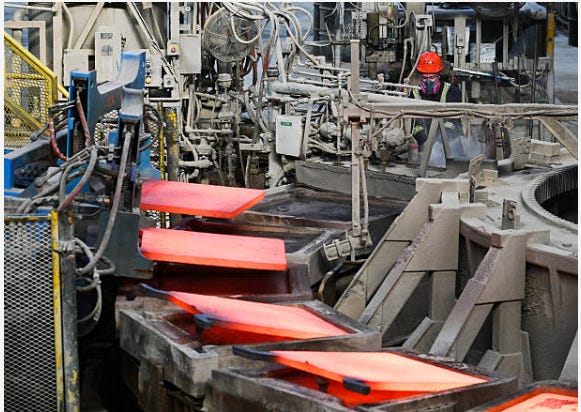
A copper cathode is high-purity copper, 99.99% or better, produced by electrorefining and deposited onto the negative electrode. It is the LME-deliverable, internationally fungible, exchange-traded benchmark form. Cathode is the reference product of the copper economy for a simple structural reason: it is standardised (LME Grade A specifications), fungible (one producer’s Grade A cathode is interchangeable with another’s), exchange-traded (priced transparently and hedgeable), and it is the feedstock for essentially all high-purity downstream products.
The Electrorefining Process
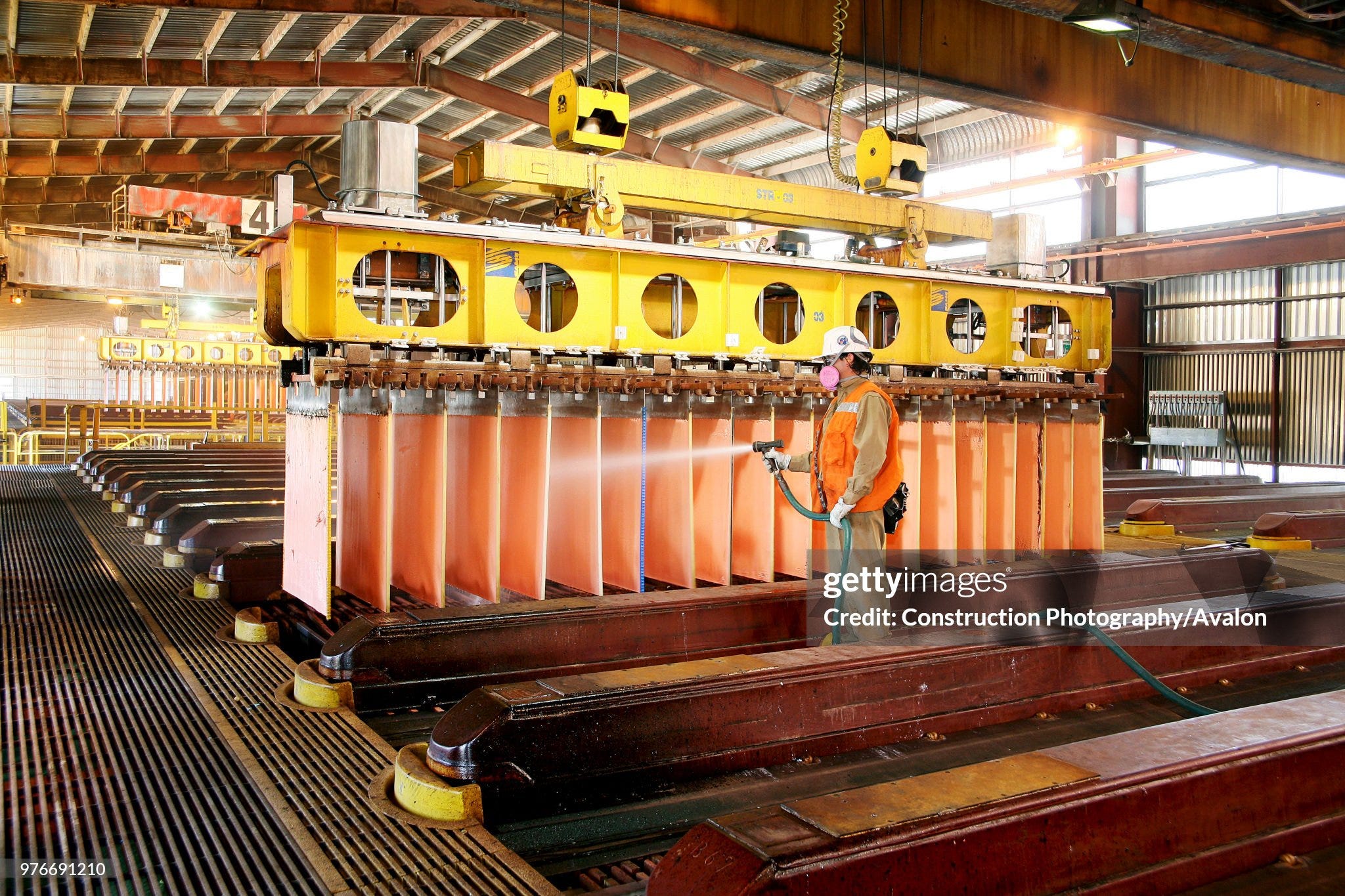
Electrorefining is the heart of the integrated copper business. Impure anode plates and thin cathode “starter sheets”, or, in modern tankhouses, reusable stainless-steel blanks are suspended alternately in a bath of acidic copper sulphate electrolyte. A direct current is passed through the cell. At the anode, impure copper dissolves into solution as copper ions; at the cathode, those ions plate out as essentially pure copper. The impurities are left behind, and their fate divides into two paths that define the economics of the whole operation.
Deleterious base-metal impurities that are more electronegative than copper (nickel, iron, arsenic and the like) dissolve into the electrolyte but do not re-deposit; they are managed by continuously bleeding and treating the electrolyte. The noble and insoluble impurities — gold, silver, selenium, tellurium and the platinum-group metals — are more electropositive than copper and do not dissolve at the cell’s operating potential. Instead they fall to the bottom of the cell as a dense sludge known as anode slimes (or anode mud). This is the single most economically important by-product in copper metallurgy
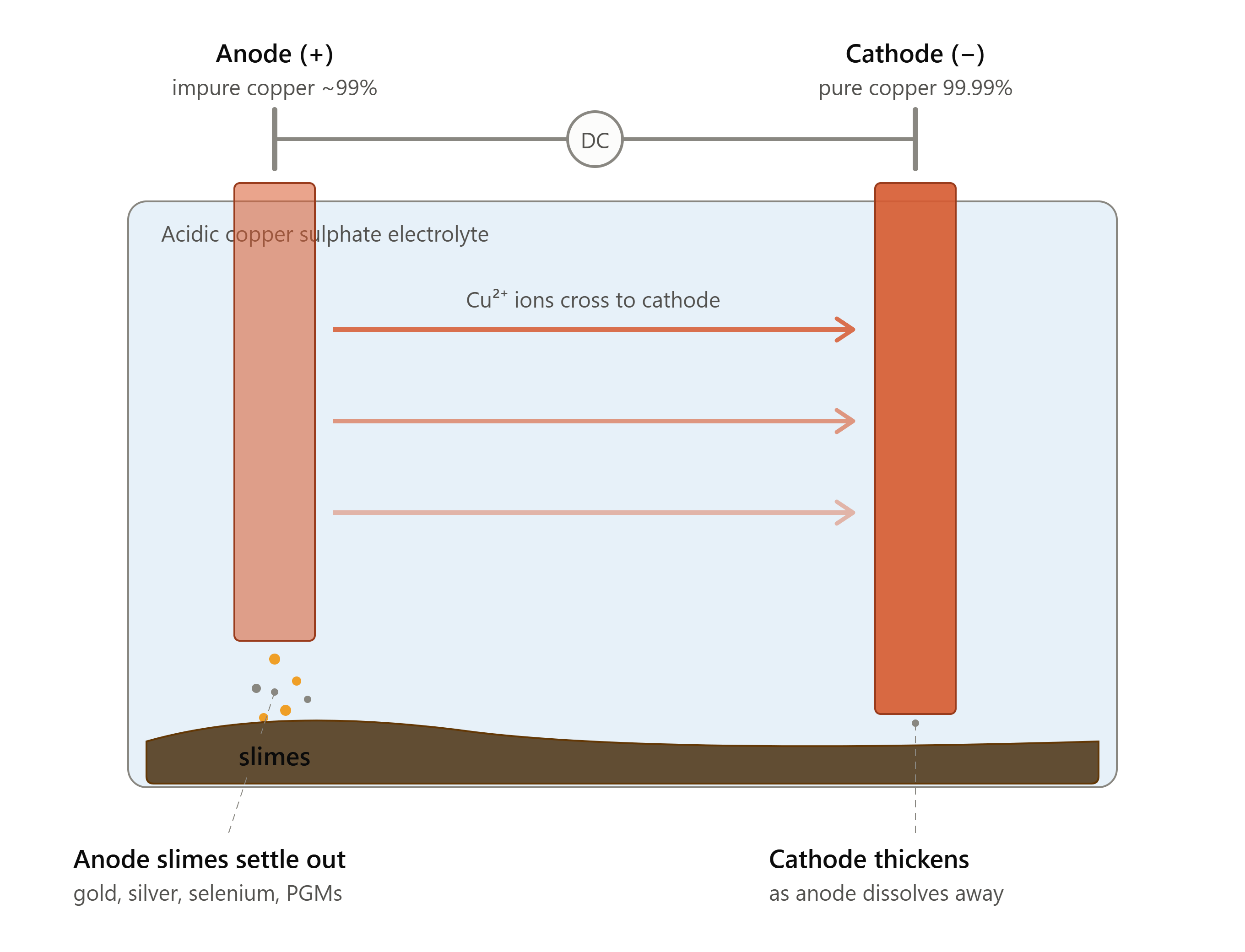
The defining economic characteristics of electrorefining are four. It is extremely electricity-intensive, the tankhouse is a major power consumer, and although electrorefining (roughly 200–300 kWh per tonne) is far less power-hungry than electrowinning (which can reach ~2,000 kWh/t), the scale makes power cost a first-order variable.
It is capital-intensive, requiring a large tankhouse and associated infrastructure. It is slow, with plating cycles measured in days to weeks, which ties up substantial working capital in metal-in-process.
The Precious-Metal Liberation — Anode Slimes as the Quiet Profit Engine
This is the richest vein in the entire subject, and it is routinely under-appreciated by generalist investors. Anode slimes are a concentrated repository of the precious and minor metals that travelled, invisibly, all the way from the orebody through concentrate, matte, blister and anode.
A representative copper concentrate carries on the order of 1–3 grams of gold and 30–50 grams of silver per tonne, small fractions that, multiplied across hundreds of thousands of tonnes, become very large numbers.
The economic magnitude is best appreciated against the backdrop of 2025–26, when the smelting industry’s traditional revenue stream collapsed. Treatment and refining charges, the fees miners pay smelters, historically about a third or more of smelter revenue, fell to a 2026 annual benchmark of $0 per tonne.
This is largely due to revenues from selling by-products, such as gold, silver and sulphuric acid.
The strategic implication is: integrating forward from anode to cathode is, to a large degree, a decision to capture precious-metal by-product value. A producer who sells blister or anode forgoes not only the copper refining charge but the embedded gold, silver, selenium, tellurium and PGMs, value that is realised only by owning the tankhouse and the slimes-treatment plant. This is the single most important reason the anode-versus-cathode decision matters economically.
Hindalco’s Birla Copper at Dahej and Adani’s Kutch Copper, which between them hold India’s roughly half-million-tonne refining capacity, both fed entirely on imported concentrate. Their entire economic reason to exist is the treatment and refining charge: the fee a miner pays them to turn concentrate into cathode. That fee has now gone to zero.
And yet these smelters still print positive copper-segment profit. Why? Because of revenues from selling by-products — gold, silver and sulphuric acid — with those by-product prices recently at record highs, so smelters with by-product-rich concentrate and good recoveries still generate robust profit that offsets the loss of processing income.
That is structurally the same statement as “gold revenue alone more than paid for all the mining and milling.” The number that is supposed to measure the core business, the processing margin, has gone to zero or negative and tells you nothing about how well the smelter is run. A by-product market (acid and precious metals) is doing all the work.
Hindustan Copper is on the opposite side of the exact same variable. HCL has effectively abandoned smelting, its smelter and refinery at Ghatsila are suspended and it is now focused on producing and selling only metal-in-concentrate, the most profitable product for the company.
That makes HCL a concentrate seller, not a processor. So the negative TC/RC that is strangling Hindalco and Adani is a tailwind for HCL when the smelter charges less (or nothing) to take concentrate, the miner keeps more of the LME price. ICRA says it almost in those words: healthy copper prices, negative TC/RC, and improving operating performance are together expected to support HCL’s earnings in FY2026. One variable, opposite sign, and in neither direction does it reflect a single thing about drilling, milling or smelting efficiency.
The Indian smelters’ current health is borrowed from two by-product markets that are explicitly flagged as unsustainable. Wood Mackenzie’s Julian Kettle has warned against over-reliance on by-products, noting gold will not stay above $4,000 an ounce indefinitely and that the sulphuric acid market faces disruption from the potential loss of oxide-leaching demand in Chile. When acid and gold normalize, Hindalco’s and Adani’s apparent profitability evaporates with the furnaces operating identically.
So the illustration to carry in your head for India is a three-body version of the same distortion. The custom smelters (Hindalco, Adani Kutch) are the direct analog, a core margin that has gone to zero, masked entirely by acid and precious-metal credits you can’t cleanly isolate in the disclosure.
HCL is the inverse, the same collapsing TC/RC flattering a concentrate seller’s realizations with no operational change. In every case the headline number is being driven by something other than how well the metal is being made.
This is why the discipline of separating process economics from by-product distortion is non-negotiable. Copper-gold porphyries can and do report near-zero or negative cash costs and appear to sit in the first quartile, but that ranking is a function of the gold price, not of mining or milling excellence.
A mine at a genuine $1.20/lb C1 sustained by $600 million of gold credits is a fundamentally different risk proposition from a mine at $1.50/lb with minimal credits: the first has a large, price-sensitive subsidy that can evaporate, while the second’s cost is what it is. Industry practitioners are blunt about the abuse, one analysis notes that copper-gold mines are “the worst culprits” because the by-product method implicitly assumes the co-product earns zero margin, which is nonsensical when gold is 30–70% of revenue.
The Anode-vs-Cathode Decision — Smelter-Only vs Integrated Refiner
Blister and anode are genuine tradeable intermediates with their own market and their own “refining charge”, a discount to refined-copper value, conceptually analogous to the concentrate treatment charge. China’s CNMC International Trading and Jiangxi Copper, for example, agreed the CIF import blister copper refining charge benchmark at $85 per tonne for 2026 term contracts, down from $95/mt in 2025 (per S&P Global Platts, 12 January 2026). This means a smelter can choose to stop at blister or anode and sell into the market rather than building and running a tankhouse.
The trade-off is clean. Selling blister or anode requires less capital (no tankhouse, no slimes plant), less power, and less technical complexity; it converts to cash sooner, reducing the working capital tied up in slow electrorefining cycles. But it forgoes the copper refining charge and, far more significantly, the precious-metal and sulphuric-acid by-product value embedded in the material.
For precious-metal-bearing feed, the case for integrating forward is strong, and grows stronger precisely when treatment charges are compressed, because by-products then dominate the margin. Selling anode or blister makes sense chiefly when a producer lacks the capital, power or scale to justify a tankhouse, when the feed is precious-metal-poor, or when proximity to a specialised refiner makes the intermediate trade efficient.
Notably, even Adani’s nominally integrated Kutch Copper imported over 26,400 metric tonnes of copper anode between February 2024 and February 2026 (per Bloomberg analysis of trade data, 29 April 2026) to feed its refinery while its own smelter struggled — a reminder that the anode trade is real and liquid.
Cathode to Downstream Forms — Rod, Billet, Cake, Ingot
Cathode is rarely a final product; it is melting stock. Remelted and cast, it becomes four principal wrought forms. Copper wire rod, typically 8 mm in diameter, the global standard for wire and cable, though produced up to roughly 23–32 mm for specialised uses, is the highest-volume semi-fabricated form and the feedstock for copper’s single largest end-use, wire and cable.
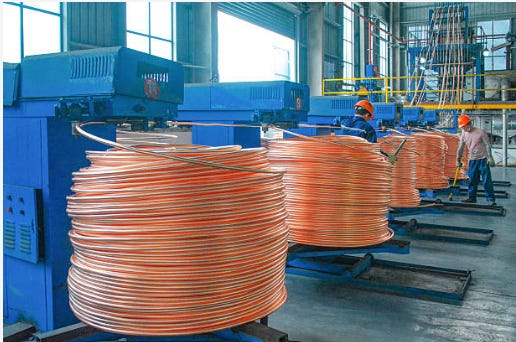
Billet is a cast cylindrical form, extruded into tubes, pipes, rods, bars and profiles (plumbing tube, air-conditioning and refrigeration tube including inner-grooved tube, and architectural profiles). Cake (or slab) is a cast rectangular form, hot- and cold-rolled into plate, sheet, strip and foil, including the copper foil used in electronics and, increasingly, as the negative-electrode current collector in lithium-ion EV batteries. Ingot is a cast form for foundries and alloying.
Most electrical applications require cathode-grade purity as the starting point, which is why the rod business sits directly atop the refinery.
The Product End-Use Map
The dominant flow by volume is cathode → rod → wire and cable, which absorbs the largest share of refined copper and serves power generation, transmission and distribution, building wiring, automotive and EV wiring harnesses, and electronics. Electrical-grade wire rod alone accounts for a majority of rod output.
The second major flow is billet → tube/pipe/profile → plumbing, air-conditioning and refrigeration, industrial heat exchange and architecture. The third is cake → sheet/strip/foil → electronics, connectors, roofing, and lithium-ion/EV battery foil.
These flows have distinct demand drivers, which is what makes the downstream map useful to an investor. Rod and wire track electrification, grid build-out, construction and EVs, the structural growth story. Tube tracks construction, plumbing and air-conditioning, more cyclical and housing-linked. Foil tracks electronics and, increasingly, the battery/EV transition, giving it a different and faster growth vector.
Specialty and alloy forms serve railways and metros (overhead electrification, Hindalco is the only Indian producer of the 19.6 mm rod and copper-magnesium alloy rod used for this), high-performance connectors, and engineering applications.
The refining charge (plus precious-metal and acid by-products) is the integrated refiner’s margin. The rod premium, the conversion margin of rod over cathode, is modest per tonne but earned on enormous volume; rod is a high-volume, moderate-per-tonne business, which is why the global rod market processes well over 11 million tonnes a year (roughly 30% of the ~26 million tonnes of refined copper) yet runs on thin per-unit conversion economics.
Moving down toward tube, billet-extruded products, specialty alloys and especially foil, the conversion premium and the defensibility of that premium both rise, because the markets are smaller, the technical qualification harder and the customer relationships stickier.
The general principle, and a key one for an investor: conversion premium and margin defensibility rise as one moves down the chain toward specialised, higher-value, more technically demanding products. Moving downstream is the principal way a copper business increases its per-tonne margin and reduces its exposure to the commoditised, thin-margin upstream — the smelting-refining middle where, in 2025–26, the core processing margin went negative.
How Costs and Processes Differ — Capex, Energy, Working Capital, and the Margin-Metric Trap
Capital intensity is heavily concentrated in the smelting-refining middle. A greenfield integrated smelter-refinery is a multi-billion-dollar undertaking — Adani’s Kutch Copper is a ~$1.2 billion investment for the first 500,000-tonne phase of a planned 1-million-tonne plant. Downstream fabrication, by contrast, is far less capital-intensive and can be added incrementally (Hindalco bought a continuous-rod facility from Polycab in 2021 to bolt on rod capacity).
Energy intensity is likewise concentrated upstream: smelting and electrorefining are energy-hungry and energy-cost-sensitive, while downstream fabrication is comparatively less so (though rod-rolling is itself meaningfully power-consuming). Working capital rises down the chain as embedded copper value accumulates in the product, and is aggravated by the slow electrorefining cycle that locks up metal-in-process for days to weeks.
Technical complexity and barriers to entry are highest in smelting-refining, deep metallurgy, environmental compliance and minimum efficient scale, and lower (though non-trivial) downstream, where process know-how matters but capital and scale barriers are smaller. Market access differs sharply too: cathode is a commoditised global benchmark sold into a transparent market, whereas downstream products are sold into specific industrial relationships that require customer qualification.
This leads to the single most important measurement point in the entire subject. Because revenue at every stage is dominated by the pass-through value of the contained copper, margin-on-revenue (net margin, gross margin as a percent of sales) is misleading across the whole chain, a rod mill and a smelter can both show 2–4% net margins that say almost nothing about the quality of the business.
The correct metrics are conversion margin per tonne, EBITDA per tonne, and by-product contribution. And by-product contribution — precious metals and sulphuric acid — must be analysed separately, it can dominate integrated-refiner economics and is driven by a different set of prices (gold, silver, acid) than the copper-processing margin itself.
The Strategic Decision and the Indian Case Study
The fundamental strategic question for any copper company is how far along the chain, concentrate, anode, cathode, rod, or specialised fabricated products to operate. Every rung trades value captured (rising down the chain) against capital and power (concentrated in the smelting-refining middle), by-product capture (which requires electrorefining), working capital, technical capability, market access and customer proximity.
There is a forward-integration logic (capture more value and by-products, get closer to the customer) and a focus logic (do one thing at minimum efficient scale and avoid the capital sink of the middle). India’s three principal copper players occupy three different answers to this question and together form an unusually clear natural experiment.
Hindustan Copper is the public-sector, only-historically-vertically-integrated mine-to-cathode-to-rod producer, and the one that retreated up the chain. It holds about 45% of India’s copper ore reserves and resources, with the Government of India owning roughly two-thirds of the company.
Around 2020 it phased out cathode production as economically non-viable and now focuses on selling concentrate, reportedly about 60% to Hindalco under a public-private partnership, with the balance sold by open tender at LME-linked prices. Hindustan Copper is the living illustration of retreating up the chain when the refining economics in the middle are poor: better to sell concentrate than to run a sub-scale, high-cost tankhouse.
Hindalco’s Birla Copper at Dahej is the model of forward integration and by-product capture. It is a port-based custom smelter-refiner that imports concentrate (over one million tonnes in the ten months to October 2025), runs a 500,000-tonne cathode operation that supplies a large share of India’s refined copper, and integrates downstream into continuous-cast rod (it ranks among the world’s top three rod producers outside China), oxygen-free and specialty-alloy rod, ACR and inner-grooved tube, and EV battery foil.
Critically, it operates a precious-metals recovery plant that refines gold and silver to 99.9% purity and also captures selenium, platinum and sulphuric acid (further value-added into DAP fertiliser). Birla Copper is, in microcosm, the entire thesis of this report: own the tankhouse, capture the slimes, integrate forward into high-premium products.
Adani’s Kutch Copper at Mundra is the illustration of the binding concentrate constraint. The ~$1.2 billion greenfield integrated smelter-refinery is designed for 1 million tonnes in two phases; its first 500,000-tonne phase was commissioned in March 2024. But it has been starved of feed: it imported only about 147,000 tonnes of concentrate in the ten months to October 2025, under a tenth of the roughly 1.6 million tonnes needed to run at full capacity, against Hindalco’s over one million tonnes in the same period (per customs data compiled by Bloomberg). Bloomberg Intelligence analyst Grant Sporre noted that “Adani’s smelter is new and so should be more efficient than many competitors, so in the short term the smelter could ramp up at a loss.”
By early 2026 it had reportedly suffered technical setbacks and produced only about 94,000 tonnes of refined copper between April 2024 and February 2026 (India Ministry of Mines data), while consultancies CRU and Wood Mackenzie forecast its 2026 contribution to global supply at anywhere from 175,000 to 385,000 tonnes. A brand-new, efficient, integrated plant cannot earn its keep if it cannot secure concentrate in a globally short market with collapsed treatment charges, the defining hazard for any stand-alone or new-entrant smelter.
The Investment Lens — Synthesis
The central insight is that a copper company’s economics are determined first by where it sits on the product chain and what it captures there. The analyst’s first task is therefore to locate the company precisely on the ladder, concentrate seller, smelter selling anode/blister, integrated refiner producing cathode, semi-fabricator producing rod/billet/cake, or specialised fabricator producing tube/foil/alloy.
Only then can the rest be assessed: margin structure (conversion margin per tonne plus by-product contribution, never margin-on-revenue), capital and energy intensity, working capital, competitive moat and demand exposure.
The key analytical questions follow directly. Where on the chain does the company operate, and why does it stop there? Does it capture precious-metal by-products, and how large is that stream relative to its copper-processing margin? Is it integrated forward into downstream fabrication, and if so into commoditised rod or into defensible specialty products? How does it measure its own economics, per tonne, or misleadingly on revenue? And what binding constraints is it exposed to: concentrate availability, power cost, the demand cycle, and regulatory/social-licence risk?
The synthesised understanding is that the copper business is a chain of distinct businesses with distinct economics. It is commoditised and capital-intensive in the smelting-refining middle, where the concentrate constraint and precious-metal by-product economics dominate, and progressively more value-added, defensible and customer-proximate moving down into specialised fabrication.
Recommendations
Begin every copper-company analysis by pinning the business to a single rung on the ladder and asking why it stops there; treat any company that cannot answer “why this rung” as carrying hidden strategic risk. Next, rebuild the income statement on a per-tonne basis — conversion margin per tonne and EBITDA per tonne, and isolate the by-product line (gold, silver, PGMs, sulphuric acid) as a separate analytical column, because for an integrated refiner that line can be the entire profit. As a concrete screening threshold, if a smelter-refiner’s by-product/metal-result contribution exceeds roughly a third of gross margin, treat it as fundamentally a precious-metals-leveraged business whose copper-processing margin is a thin cyclical overlay, and price it accordingly against gold and silver, not just copper.
Favour, for the long horizon, two profiles: integrated refiners running precious-metal-bearing concentrate with their own slimes-treatment and precious-metals refining (structurally advantaged precisely when TC/RCs are compressed), and fabricators integrated forward into defensible specialty products (battery foil, ACR/inner-grooved tube, specialty alloys) where conversion premiums are higher and stickier.
Be most cautious with stand-alone, non-integrated smelters dependent on the open concentrate market; the benchmark that should change this view is the TC/RC trajectory, a sustained return of annual benchmark TCs to the historical $60–90/tonne range would re-establish a genuine processing margin and re-rate stand-alone smelters, whereas continuation of the zero-to-negative regime (the 2026 benchmark was $0/t, spot below minus $67/t) keeps them dependent on volatile by-product and premium income.
Finally, for any smelting asset stress-test feed security against the current structural concentrate shortage (Kutch Copper) before crediting nameplate capacity.
There’s one more thing worth sitting with before you close this. Everything above traced a single path, rock to concentrate to cathode to wire, as if all the world’s copper starts life underground.
But copper is nearly indestructible: it doesn’t degrade when you use it, and it can be melted and re-formed endlessly without losing the properties that make it valuable. The wiring pulled out of a demolished building, the windings of a scrapped motor, the busbars of a decommissioned substation, that copper doesn’t disappear. It re-enters the same chain you just read about, except it skips the mine, the concentrator, and often the smelter entirely. It arrives already refined, carrying none of the concentrate constraint and none of the TC/RC economics that just dominated half this post.
Which raises the question this whole piece has been quietly leaning against: if every incentive-price and cost-curve argument for mined copper assumes the marginal tonne has to be dug out of ever-deeper, ever-lower-grade ore, what happens to that argument when a growing share of the marginal tonne is simply being recovered instead? Secondary copper is the shadow supply that runs alongside the entire primary chain, plays by a completely different set of economics, and disciplines the whole system from the outside. It’s the other half of the map. That’s the next post.
Sir so much technicality it's difficult to understand