
The Math Everyone Is Getting Wrong About Oil
Everyone is focused on "peak demand," but depletion is the silent killer. Here is why flat oil demand might actually lead to the supply crunch of the decade.

To most investors today, oil is an unwanted house guest. It is viewed as a museum piece, a sooty relic of the industrial age bound to be replaced by the clean inevitability of electricity. If you open the financial pages or watch the talking heads on television, the consensus is nearly unanimous: the “Oil Age” is ending. The International Energy Agency (IEA) produces colorful charts showing demand plateauing, while The Economist, often a wonderful contrarian indicator, boldly emblazons “The Long Goodbye” on its covers.
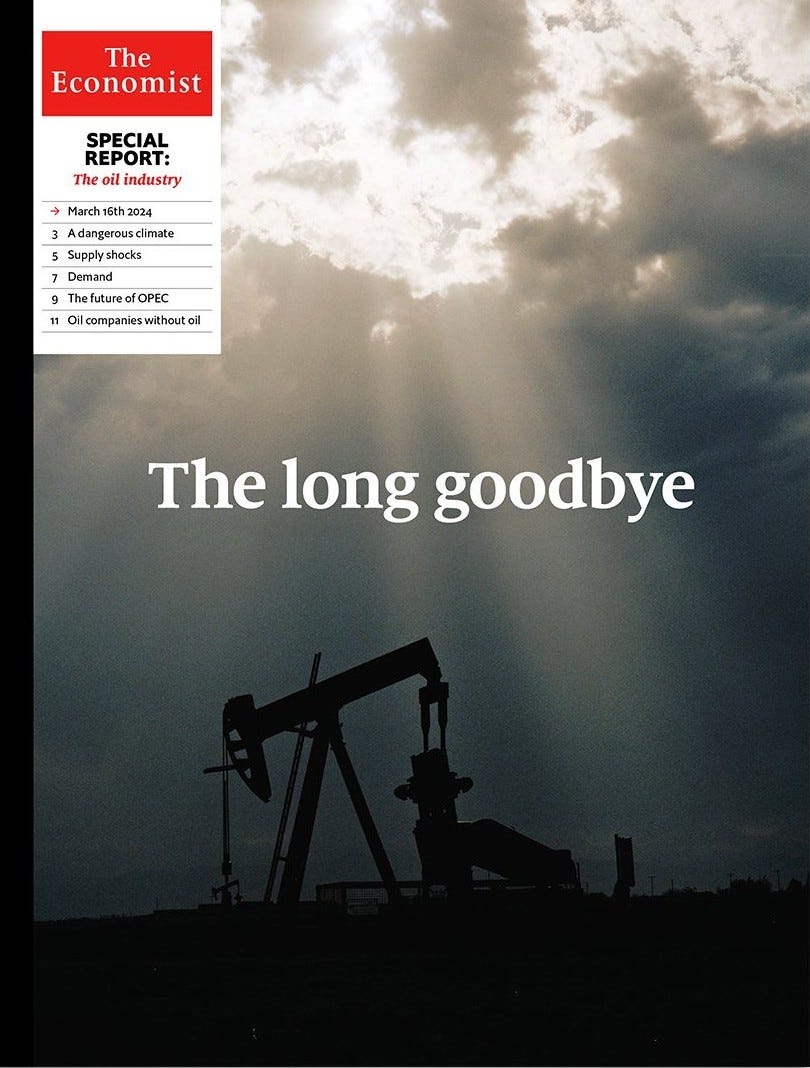
As a value investor, I have learned that when a narrative becomes this overwhelming, it pays to check the arithmetic. And in the case of oil, the arithmetic is screaming something entirely different.
The market is currently obsessed with one side of the ledger: demand. The argument goes that if electric vehicles (EVs) rise and efficiency improves, oil demand will flatten or slightly decline. Therefore, oil is uninvestable.
This logic contains a fatal flaw. It assumes that if demand stays flat, supply will naturally stay flat to meet it. But the physical reality of oil extraction is not a factory switch you can leave in the “on” position. It is a biological battle against depletion.
Today, I want to walk you through why a “flat demand” scenario is not the bearish death knell the market thinks it is. In fact, due to the misunderstood physics of decline rates and a decade of capital starvation, flat demand may well lead to the most aggressive supply crunch we have seen in decades.
The Dominant Narrative: “Uninvestable”
Let’s first acknowledge the view from the street. If you look at the S&P 500, energy’s weighting has withered from roughly 14% in 2011 to under 3% today. That is a staggering vote of no confidence from the capital markets.
The narrative driving this exodus is clear. ESG (Environmental, Social, and Governance) mandates have pressured institutions to divest. Governments have set aggressive targets for the energy transition. The rapid adoption of EVs, which accounted for about 14% of new car sales in 2023, is extrapolated into the future to suggest that gasoline consumption is on a permanent downward slope.
Under this model, terminal value is zero. Why invest in a company whose product will be illegal or obsolete in 20 years? This is a logical conclusion, provided your inputs are correct. However, this model treats oil production like a software company—assuming that once you build the product, you can keep selling it with minimal cost.
That is not how geology works.
The Physical Reality: The Red Queen Effect
Oil is a wasting asset. The moment you bring a well online, its pressure begins to drop, and its production begins to fall.
If you analyze 15,000 fields worldwide, you find that conventional oil fields have an observed post-peak decline rate of about 5–6% per year. Unconventional shale wells, the source of the American energy miracle over the last decade, are even more ephemeral. A typical shale well might lose 60–70% of its production in the first year alone.
To understand what this means for the global balance, imagine a treadmill moving backward at a speed of 6 miles per hour. That is the global decline rate. The oil industry must run at 6 miles per hour just to stay in the same place.
Here is the math that the “flat demand” crowd ignores: On a global supply base of roughly 100 million barrels per day (mb/d), a composite decline rate of roughly 4–5% means the world loses 4 to 5 million barrels of daily production capacity every single year.
To put that in perspective, the industry must find, develop, and bring online the equivalent of a new North Sea or a new Iraq every year just to keep supply flat.
If the industry stops reinvesting, if it stops running on that treadmill, global production doesn’t just plateau. It collapses. The IEA estimates that without new investment, global supply would fall by roughly 8% annually.
The Core Misconception: Why Flat Demand Is Not Bearish
This brings us to the great disconnect in modern financial modeling. Analysts spend thousands of hours trying to predict if EV adoption will reduce oil demand by 1 million barrels per day by 2030. They obsess over the demand curve.
But if natural decline removes 4 million barrels per day of capacity this year, and demand only drops by 1 million barrels, you do not have a surplus. You have a structural deficit of 3 million barrels per day.
We are already seeing the cracks form. For the last several years, nearly 90% of upstream oil investment has gone solely to replacing lost capacity, maintenance capex, rather than adding new growth.
When demand is flat, but you need to replace 5% of your supply annually, you need massive, continuous capital injection. But lead times for these projects are enormous. The IEA notes it takes almost 20 years on average to bring new conventional upstream projects online from the moment of initial license to first oil.
We are consuming oil today from projects sanctioned a decade ago. The projects we are not sanctioning today are the shortages we will face in the 2030s.
Capital Starvation and the ESG Loop
In a functioning market, high prices or looming shortages would trigger a flood of capital into the sector to build new supply. But we have broken the feedback loop.
Western oil majors and global banks have faced immense pressure to limit new oil projects. This isn’t just about optics; it’s about the cost of capital. Policies centered on ending financing for fossil fuel projects have worked. OPEC has warned repeatedly of a chronic investment shortfall.
In 2015 and 2016, following a price crash, the industry saw “historic investment cuts.” We saw it again in 2020. The result is that the global hopper of shovel-ready projects is empty.
This has created a self-reinforcing cycle. Investors, burned by the volatility of the last decade and pressured by ESG mandates, have demanded that oil companies stop drilling for growth and start returning cash. Oil executives, whose compensation is now often tied to Return on Capital Employed (ROCE) rather than production growth, have happily obliged. They are paying down debt and buying back shares rather than drilling holes in the ground.
We have effectively incentivized the liquidation of the industry. While that sounds bad for the world, it is exceptionally good for the remaining shareholders of these companies.
The Twilight of Shale
“But wait,” the skeptic asks. “What about the U.S.? Shale can just turn the taps back on.”
For the last decade, U.S. shale was the swing producer. It was short-cycle oil—you could drill a well and get oil in months, not years. It bailed out the world repeatedly. But looking at the data from the Permian Basin, it appears the easy money has been made.
Shale is not dead, but it is entering its middle age. The “sweet spots”, the Tier 1 acreage where you stick a straw in the ground and money shoots out, are being exhausted. At the current drilling pace, many public Permian operators will run out of top-tier inventory in 3 to 4 years.
Furthermore, we are seeing the consequences of drilling too densely. “Parent-child” well interference happens when you drill a new well too close to an old one, damaging the pressure in the reservoir and reducing the output of both.
The Dallas Fed reported that breakeven prices in the Permian have risen 20–30% since 2022 due to inflation in labor, steel, and diesel. As one industry CEO put it bluntly in late 2023: “We have begun the twilight of shale… The U.S. isn’t running out of oil, but she sure is running out of $60-per-barrel oil.”
U.S. producers have learned their lesson from the 2015 and 2020 crashes. They are no longer interested in flooding the market to drive down prices. They have embraced capital discipline. The era of cheap, infinite growth from US shale is over.
What Markets Are Pricing vs. What Matters
The market is pricing in a perfect execution of the energy transition. It assumes EV adoption will accelerate linearly, that political mandates will hold, and that renewables will seamlessly replace hydrocarbons.
It is not pricing in the decline rates. It is not pricing in the fact that replacing reserves is getting more expensive. It is not pricing in the geopolitical risk of a world where spare capacity, the safety buffer against shocks, has evaporated.
This is a classic case of false precision. Analysts are using Discounted Cash Flow (DCF) models that assume 2% terminal growth decline forever, while ignoring that the physical supply might fall off a cliff much faster than demand does.
What This Means for Investors
I am not here to give you a price target. Predicting the price of oil next month is a fool’s errand. However, recognizing a mispriced asset class is the job of a value investor.
Currently, you can buy oil companies with fortress balance sheets, paying high dividends, for low single-digit multiples of their cash flow. You do not need oil to go to $150 to make money here. You simply need oil to not go to zero.
If the “flat demand” scenario plays out, which is the consensus bear case, and supply declines at 4% annually, we will see a squeeze in prices that will make the 1970s look like a dress rehearsal. The companies that own the remaining productive reserves will be printing cash.
The opportunity here lies in the fragility of the system. By starving the industry of capital for a decade, we have ensured that supply cannot respond quickly to any upside surprises in demand or geopolitical disruptions.
We have built a system with no shock absorbers.
The consensus believes the movie is over and the credits are rolling. But if you look at the geology, the physics, and the lack of investment, it looks to me like the most interesting part of the film is just beginning.
This analysis is intended as a high-level framework to question prevailing narratives and encourage deeper thinking around the oil sector. It is not the full thesis, nor is it a stock-specific analysis, but rather the groundwork for a more detailed research series.
Future work will methodically examine key components of the oil ecosystem, dissecting supply dynamics, capital cycles, and the areas where real mispricings may exist. It will aim to differentiate genuine opportunities from misleading signals while providing a more granular view of how systemic fragility impacts potential outcomes.
Oil as material will outlive oil as fuel.
Crude oil is used in 400+ distinct industrial and consumer applications, far beyond fuel.
Professor Sanjay Bakshi is very bullish on this sector in long term.
Thank you for the article.
Great work, as always. If you can write a follow up, how are you planning to benefit from your macro view, that would be great !